

Every few years, my phone starts buzzing with messages from colleagues outside of professional philanthropy asking excitedly whether I’ve seen “The Next Big Thing” when it comes to manna-from-heaven philanthropic capital. Fifteen years ago, it was, “Did you hear about The Giving Pledge?” A decade ago, it was, “Did you hear about the tens of billions of dollars sitting in donor-advised funds?” Five years ago, it was, “Did you hear about MacKenzie Scott’s giving?” This year it’s, “Did you hear about the massive new wealth about to be created when OpenAI and Anthropic go public?”
Yes, I have. And no, this isn’t going to be as transformative as you think.
The most recent surge of interest around the forthcoming crop of artificial intelligence billionaires was driven in part by Nan Ransohoff’s compelling essay this past May, “The Third Wave of American philanthropy.” In it, she tries to calculate the potential new wealth creation that will come with Anthropic and OpenAI liquidity events, what that means for the social change sector, and calls out the opportunities (and perils) associated with how best to direct that capital toward high-impact social change work. There are too many follow-up essays (both supportive and critical) written by other observers to list here, but suffice it to say the original essay quickly made the rounds in the nonprofit and social change world, igniting a predictable cycle of philanthropy and fundraising FOMO. “How do we position ourselves to tap this new wealth?” was the question that began appearing in my WhatsApp and inbox.
New philanthropic capital will no doubt become available to social change leaders and organizations moving forward. But I doubt it represents a truly transformative shift in the philanthropy landscape.
What follows are practical recommendations for how savvy organizational leaders and boards can assess the real opportunity these forthcoming liquidity events represent. Equally importantly, I detail how to avoid incurring significant opportunity costs by over indexing fundraising efforts towards a small crop of new donors.
Philanthropy Trends as Fad Diets
I liken philanthropy trends to dieting trends: they constantly change over time, there is often a kernel of truth to the current zeitgeist, and they’re almost all overblown and hyperbolized. If earlier obsessions over the Giving Pledge, DAFs, and MacKenzie Scott were the low-fat and paleo diet phases of fundraising and philanthropy “disruptions,” then today’s froth around “AI money” is analogous to the current obsession with high-protein diets. Will more protein in your diet, and more AI money in your budget, help? Absolutely. But is protein, or AI wealth, alone the singular, magical solution to long-term health and financial sustainability? No.
Using rough estimates, Ransohoff’s calculates a potential minimum of new “AI giving” at nearly $40 billion and estimates an upper estimate at $100 billion. But as many others have pointed out, it’s easy (and correct) to poke holes in those assumptions. GiveDirectly’s Nick Allardice put it succinctly: “I’m skeptical that $50 billion a year will move. The base rate for giving by the ultra-wealthy is about 1.2% of assets a year, many times lower than what Nan forecasts.” We could quibble forever about whether this new crop of ultra-high-net-worth donors will behave differently than previous donors; I’ll side with Nick here and agree that “humans are humans” and eventual payout rates will be closer to the floor than the ceiling. Michael Kavate recently made similar arguments in Inside Philanthropy (“Are AI Donors Unicorns?”); his piece is well worth the read, as is as is Nick Martin’s helpful synthesis of most of the major “takes” on Ransohoff’s original essay (“The $100 Billion Argument: A Reader’s Guide to the Philanthropy Fight of 2026“).
More concerning are the arguments that AI donors simply know how to do philanthropy better. This reflects a broader Silicon Valley bias that goes beyond giving, rooted in a belief system going back decades associated with tools for self-sufficiency and cybernetics (I highly recommend the dense but fascinating book, “From Counterculture to Cyberculture: Stewart Brand, the Whole Earth Network, and the Rise of Digital Utopianism” by Fred Turner for a deep dive into all of it). That slant towards “digital utopianism” shows up in much of the discourse around the forthcoming wave of AI wealth, as Ransohoff lays out in this visual:
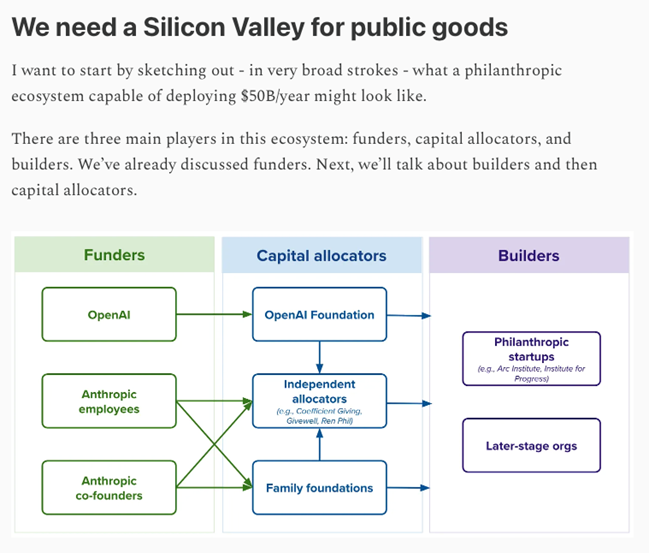
While a constructive critique of the above requires a separate essay, it’s worth calling out a few non-trivial challenges at a practical level:
- If there’s one thing most of the social sector doesn’t need more of, it’s startups. We already suffer from chronic pilot-itus. I’m personally more interested in where we can accelerate proven interventions with additional capital rather than search for the “new new thing.”
- Rather than VCs, we need more “private equity” investors in philanthropy. Capital allocators that can roll up high impact peers, provide best-of-breed business operations platforms, and then scale a smaller number of larger organizations and movements to better move the needle on complex social change agendas are sorely lacking. This is a fundamentally different approach to “spray and pray”-type venture capital investing.
- For every lauded Silicon Valley philanthropist in the past few generations – Pierre and Pam Omidyar, Jack Dorsey, Craig Newmark, and Reid Hoffman are good examples – there are an equal number of less helpful (non) donors – think Elon Musk, Peter Thiel, or Marc Benioff. Silicon Valley has seemingly no greater propensity for producing “good” philanthropists relative to the rest of the world, and I have yet to see evidence suggesting that ratio will be different with the next crop of ultra-high net worth donors. (Note, also, the gender bias in the lists above, an issue that remains chronic in the valley.) As Kavate bluntly (and correctly) points out in his piece, “As far as I can tell, virtually the only major billionaires who have ever consistently spent 10% or more of their fortunes annually are MacKenzie Scott and Chuck Feeney. They are practically unicorns — and hardly a basis on which to plan the future.
All of this is a long way of saying: new philanthropic capital will definitely flow into the social sector in the coming years thanks to AI company liquidity events. But the actual figures may be lower than some of the more breathless estimates. Additionally, the argument that the new donors/capital allocators will be better/smarter/more adept at efficiently picking winners in the social change arena – a notoriously difficult exercise even for the most seasoned philanthropist – is contestable.
How to Surf the Third Wave
So, at a practical level, is it worth paying attention to this new wave of philanthropy? Yes. But a balanced approach is a good bet for right-sizing level of effort with potential returns.
First, this new wave of wealth creation won’t be the last. If there’s anything predictable about our current capitalist economies, it’s that they’re capable of producing billionaires on a regular basis! The new crop of ultra-wealthy donors won’t be the last. Don’t let FOMO drive fundraising strategies and tactics, because the risks of ignoring other high-priority donors are real.
Second, and related, as every good fundraiser knows, the biggest barrier to raising funds (whether for a nonprofit, a social enterprise, or a donor collaborative or pooled fund) is time. Even the largest organizations with the biggest internal fundraising teams can’t chase all the donor prospects all the time. Everyone must triage. Some of the forthcoming Third Wave Donors will be fantastic partners. Others will be deeply frustrating to work with, whether because of “analysis paralysis,” preexisting biases and arbitrary preferences, ego, or any number of predictable foibles. Donors are humans, not machines, and their philanthropy reflects that. The risks of unsuccessfully chasing a single longshot Third Wave Donor for 18+ months is real for many social change organizations, regardless of the donor’s on-paper wealth. Pump the brakes searching your LinkedIn for friends who have friends who work at OpenAI.
Third, Third Wave Donors will indeed most likely be biased positively towards effective altruism, a philosophical approach to giving that has taken deep hold in Silicon Valley. If you’re going to prioritize those donors moving forward, best to have some hard data available to make the case for why your organization, program, or intervention is effective…and cost effective. Pure storytelling and compelling narratives are unlikely to be sufficient for persuading your typical Third Wave Donor.
Finally, diversity is always a virtue for fundraising, a hard lesson that too many organizations working on international development learned last year with the sudden collapse of USAID. Putting all your donor prospecting eggs in the Third Wave Donor basket is unlikely to be the right long-term strategy. Donors come and go, floating in and out of issues over time. The risks of over-indexing toward early wins with Third Wave Donors is real. If and when they exit a sector or issue, an organization, program, or donor collaborative needs a viable pipeline of diverse donors to fill those gaps. Ignoring every other donor type in the interim to focus solely on Third Wave Donors strikes me as a risky approach.
Like healthy dieting, a balanced approach to building relationships with Third Wave Donors feels smart. They represent a new prospective donor segment for many fundraisers…but something less than a transformative shift in philanthropy writ large.