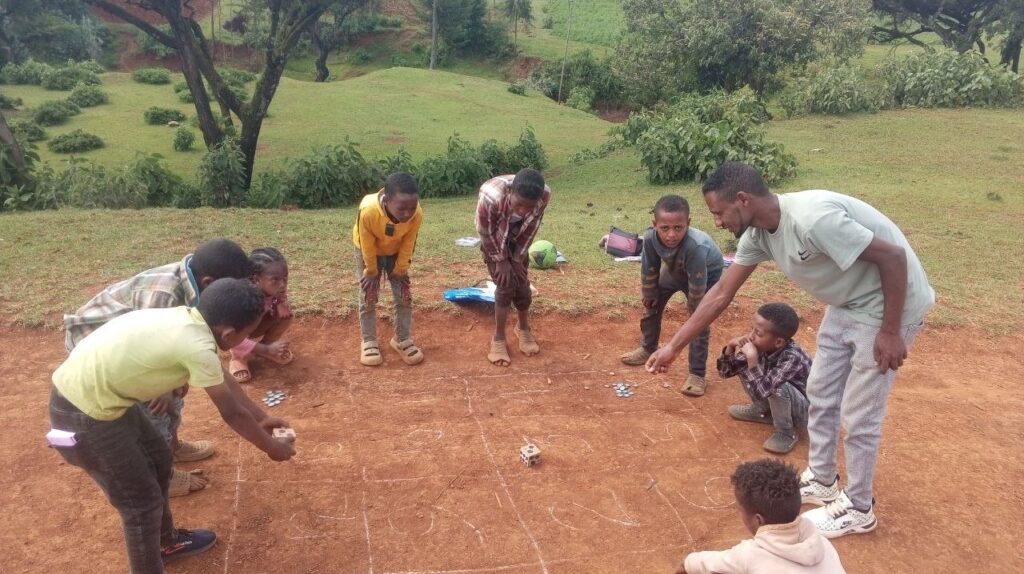
Preparing for the 2025/26 Speed School program in Ethiopia, it was clear to the Geneva Global team that we would fall short of our desired number of classes in Amhara. The reason was simple: the armed conflict that affected many of the region’s zones had resulted in thousands of inoperable primary schools, either dilapidated, totally destroyed, or taken over to lodge soldiers or rebels. This left estimates of between four and six million school-aged children with no classes in which to learn (Source: Ethiopia Education Cluster/UK Government, Country Policy and Information Note: June 2025, Version 1.0).
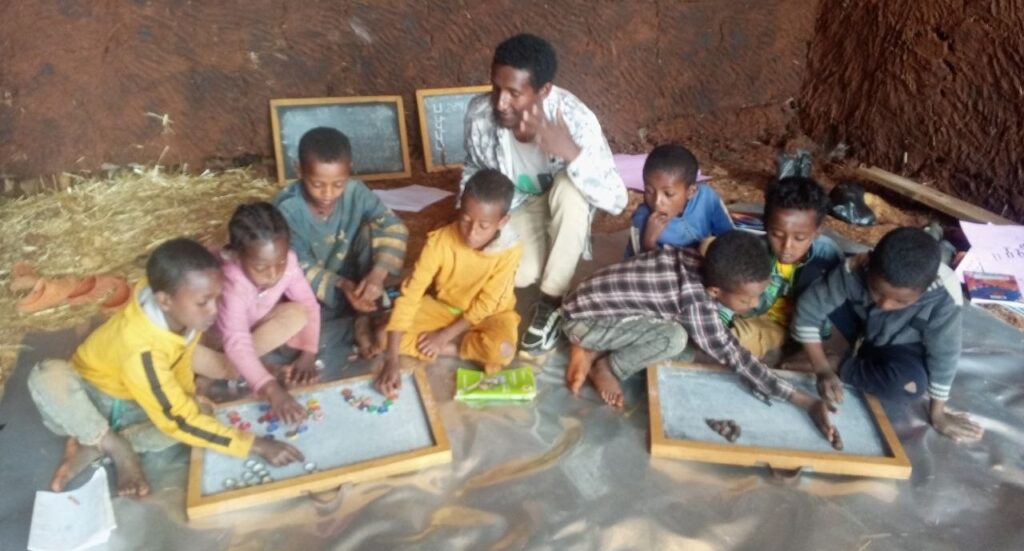
Working closely with the regional education bureau, two longstanding NGO partners Development through Adult and Non-formal Education (DANFE) & Amhara Development Association (ADA), and colleagues from Bahir Dar University, Geneva Global took a model we first used in Uganda during its two-year COVID-19 school closure to allow students to continue their learning at home. Specifically, the home-based instruction (HBI) initiative created 70 “learning pods” of eight children each (560 total – 42% girls) to follow a condensed version of the grades one and two curriculum from the relative safety of one of their homes or another safe village location organized by their parents.
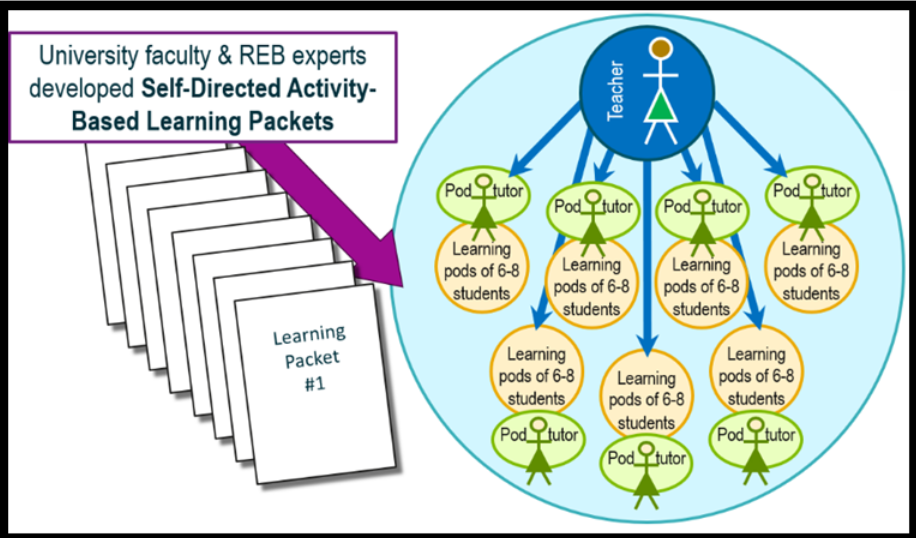
Meeting an average of four hours a day and five days a week, the students engaged in a precise sequence of learning tasks captured in learning packets developed
by professors from Bahir Dar University and an education expert from the regional education bureau, accompanied by Geneva Global. All tasks guide the students through in highly active, play-based learning with the dual aim of giving them a solid foundation of literacy and numeracy skills and nurturing their mental health and psychosocial healing, confronting the trauma of living in the midst of active armed conflict. Each day, dedicated “pod tutors” shepherd learning pods through the learning packets. The tutors are trusted, literate local community members, often a family member, chosen by the parents for the role. The local school principal or other leader assigned teachers to monitor and ensure the learning of seven learning pods, visiting each learning pod every two or three days.
On 15 and 16 June, Geneva Global brought the main partners from the four collaborating institutions and two HBI teachers to our offices to assess the conduct and impacts of HBI’s trial year. While we are still completing a final report (which we will be excited to share soon), we are keen to share now some of the initial findings. These include both the shared analysis from the June meeting and data and plans that Geneva Global and the partners have compiled since.
Looking at the main successes from the trial implementation, the partners highlighted the following:
- Attainment of foundational literacy and numeracy was high for almost all students
- Students engaged in the learning activities enthusiastically and joyously, with some tasks more challenging than others, especially for Environmental Science
- The vast majority of students attended regularly and for the full learning period, and almost none dropped out
- Evidence of psychic healing was great, with students coming out of their “shells” to exhibit strong collaboration, communication, creativity, confidence, joy, and other personal skills
The partners identified a few prominent factors as contributing to these positive outcomes:
- The use of play-based methods to achieve holistic learning, featuring competencies across academic, practical, and personal domains equally
- The strong attention and active engagement of parents, local community leaders, and school supervisors
- The daily accompaniment and support of the pod tutors and the regular interactions with the pod teachers, with both groups benefiting strongly from the training they received and the quality of the learning packets
- The strong and irreplaceable support of the REB and WEOs, through coordination, supervision, monitoring, and facilitation of program implementation
Among the challenges identified are:
- The absence of supplementary reading materials, limiting learning to the content of the learning packets
- Persistent worries about security, with sessions sometimes postponed to other days due to a pod teacher’s (or sometimes even students’) inability to arrive to or conduct learning at a location safely
- The fact that different pods were able to proceed through the learning packet at different paces, sometimes a matter of the students’ abilities and at other times a factor of the pod tutor’s or teacher’s understanding of the content within the packet and its ability to use the activity-based methods
The partners agreed enthusiastically that the HBI model should continue and grow, giving many more out-of-school children that opportunity to participate in formal education even if their schools are not operating. The plan for 2026/27 is to continue working with the existing pods, taking them to the next grade levels and to add new pods, which will now comprise 12 to 14 students. The aim is to operate 217total pods and reach 2604 total students. in Tigray (1,260 children) and Amhara (1,344 children), with 31 HBI teachers’ providing critical learning opportunities for children affected by disruptions to formal education.
Geneva Global looks forward to sharing a more complete and analytical report in the coming few months and to extend the story we can tell with our partners as we join them in giving many more children and their families a ray of hope during the ongoing conflict. Our own hope is that HBI will become obsolete as a strategy in the very near future.