
Each year, more than 12 million girls are married before reaching adulthood, with the highest prevalence in sub-Saharan Africa at 31 percent. Child marriage remains one of the most widespread violations of girls’ rights, denying millions the opportunity to stay in school, protect their health, live free from violence, and fulfill their potential (United Nations, n.d.).
Investing in girls’ rights is therefore critical to ensuring they have the freedom to determine their own futures. At Geneva Global, education is central to this work. Through our Speed School program, a 10-month Accelerated Education Program, we equip out-of-school girls and boys aged 9 to 16 with the knowledge and skills they need to transition into formal schooling and thrive there. Using competency- and activity-based learning approaches, the program encourages students to think critically and take greater ownership of their learning far into their formal education and beyond; especially potent for girls. Getting children into the classroom is only part of the work. Keeping them there requires the involvement of the entire community. Through Self-Help Groups (SHG), we engage parents and community members to support children throughout their education. We strengthen teachers’ capacity to provide quality teaching and learning, and we collaborate with governments to support program adoption and sustainability.
Article 26 of the Universal Declaration of Human Rights recognizes education as a fundamental right. Guided by this principle, Geneva Global’s education programming works to expand access to quality education for children who have been excluded from the classroom. For more than a decade in Ethiopia and Uganda, we have seen how education, combined with meaningful community engagement, can help address barriers facing girls, including child marriage.
The relationship between education and child marriage is critical. Evidence shows that up to 66% of women aged 20 to 24 years who were first married or in union before age 18 in Uganda had no education at all compared to 49% of women with primary education and 15% with secondary or higher education (UNICEF, 2022). Research has also estimated that nearly one million child marriages in Uganda could be prevented by 2030 if all girls completed secondary education (Save the Children, 2018).
In Ethiopia, the prevalence of child marriage among women aged 20–24 declined significantly over a 25-year period, from 69% in 1991 to 40% in 2016. UNICEF identifies keeping girls in school and ensuring access to quality education as important strategies in efforts to prevent child marriage (UNICEF, 2022). This association is a strong motivation in Geneva Global’s efforts to create safe, supportive environments where girls can access quality education, participate and learn fully, and realize their potential.
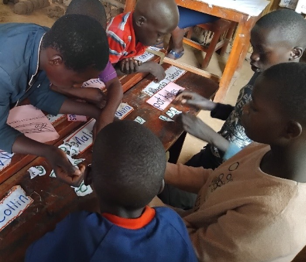
In Uganda, the experience of Eva, a 14-year-old P4School student, illustrates this connection profoundly. As Eva approached graduation and the transition to formal school, her facilitators noticed that she had begun missing class frequently. Concerned, they contacted her guardian but received little response. They later learned that Eva had been sent away to be married.
Her facilitators and the Geneva Global Uganda team knew they had to act. The Center Management Committee, a group of six Self-Help Group members who volunteer to monitor education-related issues affecting children in their community, mobilized around Eva’s right to an education. Their advocacy helped bring her situation to the community’s attention and reinforced that her education should not end with marriage. With community advocacy and the prospect of legal action, Eva returned to school, where she received counseling and support to reintegrate into the program. Today, she is nearing completion of Speed School and preparing to continue her formal education, now in a conventional government class.
In Ethiopia, Geneva Global school facilitators, Ubah and Selamawit, encountered a similar challenge in two different regions. Each noticed increasing absenteeism among girls in their classes and refused to accept this situation as inevitable. In the Somali region, Ubah brought together female secondary school alumnae and the Parent-Teacher-Student Association to lead a campaign challenging community norms around child marriage and emphasizing the importance of girls’ education. In Southwest Ethiopia, Selamawit similarly mobilized community members to raise awareness about the effects of early marriage and the value of keeping girls in school. As a result, 10 girls who had dropped out because of early marriage returned to school.
The experiences of Eva, Ubah, Selamawit, and the girls who returned to their classrooms remind us that lasting change does not happen through education alone. It happens when communities choose to stand behind girls and their right to learn.
As we celebrate International Day of the Girl, we are reminded that every girl deserves the freedom to determine her own future. Achieving that freedom requires more than opening classroom doors. It requires families who support girls’ education, teachers who create spaces where they can thrive, communities willing to advocate for their rights, and systems that protect their opportunities. In other words, it takes a village.
At Geneva Global, we are proud to be part of that village, working alongside communities to expand access to quality education and help dismantle the barriers that stand between girls and the futures they choose for themselves.