
Here at Geneva Global, we take special joy in celebrating the International Day of Play. This is because we have seen the fantastic impacts of play on learning and teaching implementing Speed School in Ethiopia over the past 15 years and in Uganda since 2016. These impacts are evident first in the recovery of nearly one million children who had missed the chance to enter school or proceed past the first years. Even more exciting, though, are the transformations that this alternative accelerated education models have produced among the students, teachers, schools, and other educators who have been part of this effort. Speed School graduates routinely excel as they transition to mainstream (see here, here, and here). In many schools, Speed School’s play-based pedagogy infiltrates the instructional practices of mainstream teachers, sometimes occurring as an organic, person-to-person process and at other times involving more formal guidance from school leaders and district agents. Speed School’s approach to teaching and, even, to teacher training is also helping to bring change to how the two countries train, supervise, and support their teachers system-wide.
The “Peacock” Level 2 Speed School Class at Saint Jude Mbaale Primary School in Mayuge District, Uganda exemplifies how play-based learning has become a powerful tool for engaging learners and improving educational outcomes. Here, teacher Mwanja Daniel relies on his deep trove of educational games to strengthen his students’ literacy and numeracy skills and take them on a consistently exciting journey through Uganda’s theme-based primary curriculum.
One such learning activity is the “Word-and-Number-Treasure Hunt.”
Mwanja divides learners into small groups to discover cards containing letters, words, and mathematics problems that he has hidden around the classroom and school compound.
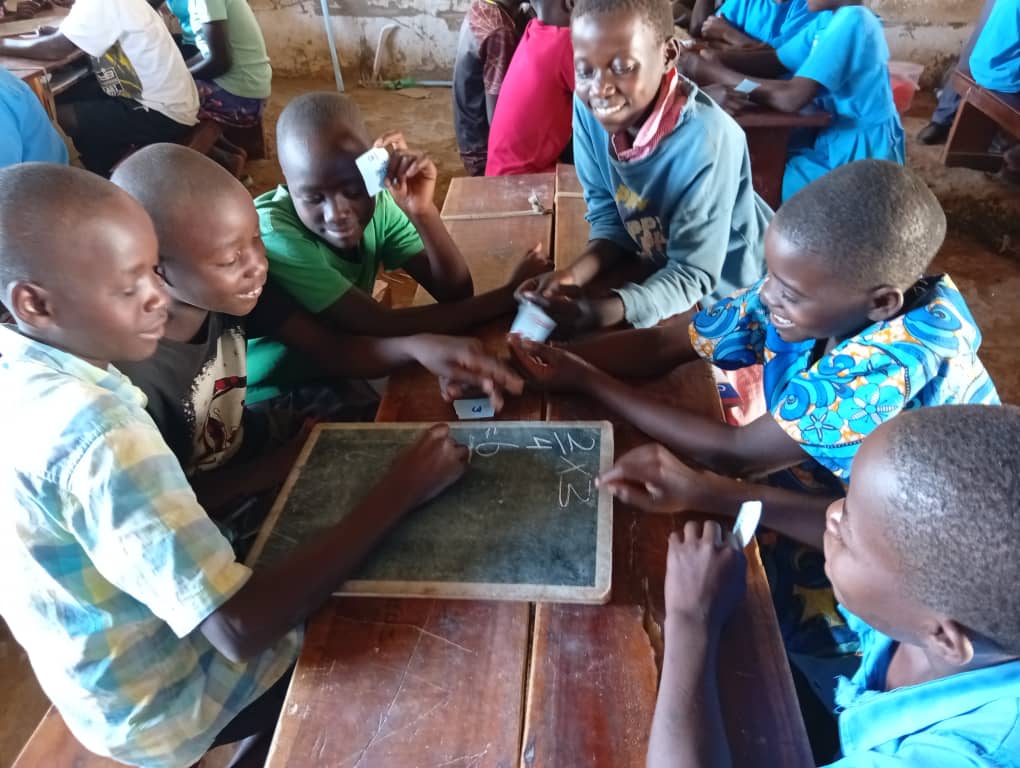
Upon finding a card, the small groups of students work together to identify the letters, read and define the words, or perform the calculations, presenting the answers to their classmates upon returning to their desks. Mwanja asserts that this manner of activity-based learning has transformed his lessons into exciting learning adventures. Specifically, he explained that “play-based instruction helps children learn naturally. When learners are playing, they are relaxed, motivated, and eager to participate. I have seen significant improvements in attendance, confidence, teamwork, and academic performance because children enjoy learning through play.”
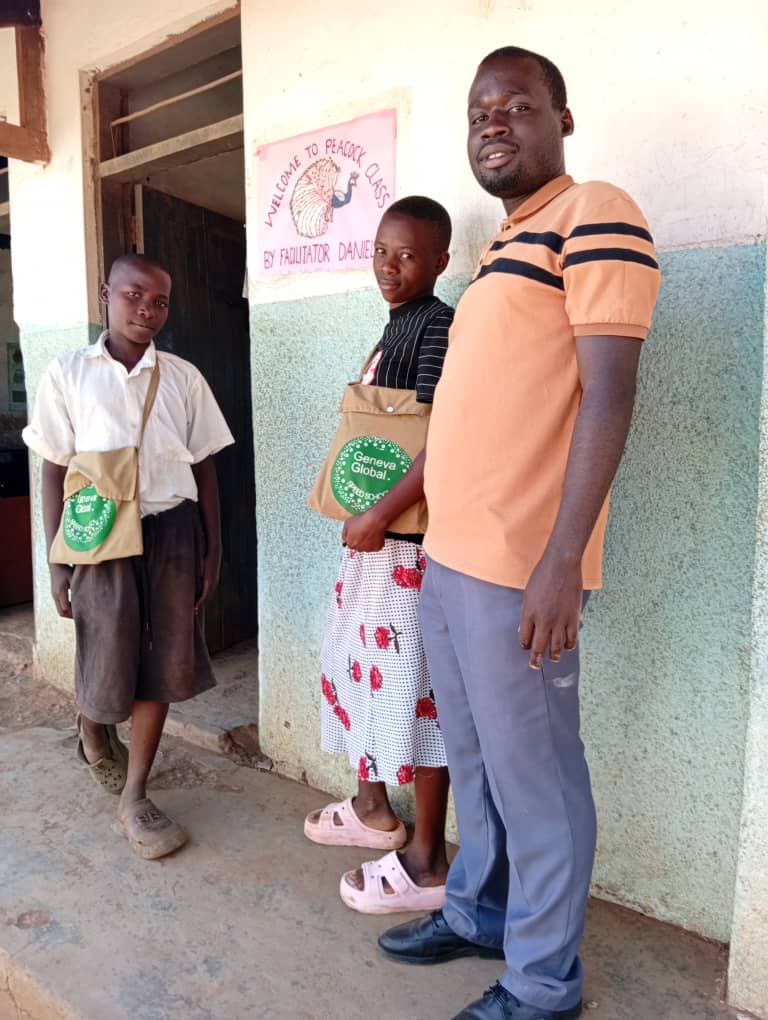
Kantu Hamidu, a member of the “Peacock” class, mirrors this enthusiasm from his perspective as a student. Previously, he had been shy and hesitant to participate in class discussions.
However, through learning activities such as the Treasure Hunt Game, he has become more confident and competent in identifying words, reading aloud, and solving simple arithmetic problems with his classmates.
Kantu Hamidu, a member of the “Peacock” class, mirrors this enthusiasm from his perspective as a student. Previously, he had been shy and hesitant to participate in class discussions. However, through learning activities such as the Treasure Hunt Game, he has become more confident and competent in identifying words, reading aloud, and solving simple arithmetic problems with his classmates.
Indeed, he is now both a helper and an inspiration to his classmates. Kantu explained that “… learning through games … makes school fun. When we play and learn together, I remember things more easily, and I am not afraid to answer questions.” His classmate Nabukenya Hadija added that “Playing while learning helps me understand lessons better. I enjoy working with my friends, and I feel happy when we solve challenges together.”
This experience at St Jude Mbaale Primary School demonstrates how creative play-based learning activities can foster learner engagement, build confidence, and improve educational outcomes for children in the Speed School program.
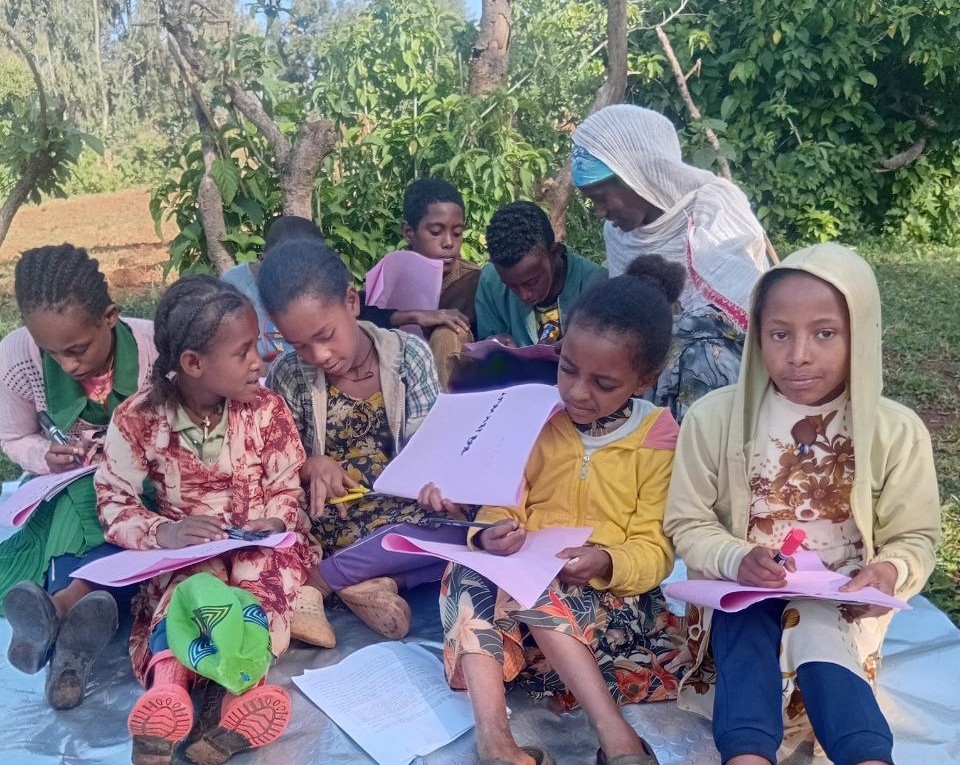
The experience of play-based learning in Amhara Region, Ethiopia, highlights another highly valuable dimension of this approach. There, thousands of schools have been completely shuttered due to an active armed conflict, banishing millions of students and tens of thousands of teachers from learning and teaching (Addis Standard, 31 March 2025). Inspired by a strategy we enacted during Uganda’s two-year COVID school shut-down, Geneva Global has joined with the Amhara Regional Education Bureau, a few woreda education offices, University of Bahir Dar, and two prominent local NGOs — Amhara Development Association (ADA) & Development through Adult and Non-Formal Education (DANFE) — to operate a pilot Home-Based Instruction initiative. Creating “learning pods” of eight students that can operate in the relative security of a family compound, the HBI program gives children (and their parents) a chance to continue to dream of and work towards a better future through formal education. Accompanied daily by a local “pod tutor” whom the students’ parents select and supported about twice a week by a schoolteacher, each pod proceeds through a sequence of learning packets that cover the official curriculum with highly play-based activities.
As students learn the condensed curriculum, however, the emphasis is on providing students (and their tutors and teachers) a chance to experience joy, hope, and a focus on something positive in the midst of the trauma that surrounds them. Learning features movement, guessing games, teamwork, music and art, competition, and discovery, among other intellectually and physically engaging activities. Examples of such activities include:
- Placing numbers in a matrix on the ground, directing students to jump on two that when added, subtracted, multiplied, or divided equal a number that one of them has said.
- Creating their own water filters using a mix of materials to test which removes the impurities from muddy water best.
- Making up stories about the current situation in their community to create an illustrated book.
- Silently acting out or mimicking an animal, a household task, a job, a local place, etc. for the other students to guess.
- Playing “slap the letter,” with one student naming a letter or providing another prompt e.g., a word that begins or ends with the letter – for the other students to be the first to slap, or grab, from a set of letters (words, pictures, or numbers) placed before them.
- Listening to cultural stories, singing cultural songs, playing cultural games, and so on.
All tutors and teachers understand that the program’s success resides in two aspects. One is certainly the students’ attainment of the foundational literacy and numeracy and other curricular elements they will need to progress well in school once classrooms re-open. The other is the students’ overall psychosocial well-being and healing. Indeed, the explicit instruction is that teachers and tutors should not rush students through the learning packets. Rather, they should proceed at the students’ true pace of learning, ensuring that learning activities favor first and foremost their mental wellness. Now over halfway through the pilot activity’s first year, the reports are very positive, with teachers, tutors, parents, students, and authorities all avowing that both learning and mental well-being are happening in joyous, hopeful ways. Worknesh Mengsha, a Pod Tutor from Deresgie village captures this conclusion as follows: “What has changed most is not only the children’s progress in reading and numeracy, but their socialization, confidence and emotional well-being. Learning is happening at their own pace, and it shows.”
So, as we celebrate the 2026 edition of the International Day of Play, we wish all our partners similar joy as they feature play as an essential part of teaching and learning all the days of the year.