
Inclusion in education is often discussed as a technical challenge, centered on devices, teacher training, and classroom adaptations. While these components matter, they are frankly not where inclusion begins. For children with disabilities, inclusion must start earlier, with a belief by all – including parents, educators, and the children themselves – that they are fully capable of learning and belong in learning spaces (UNESCO). As disability rights advocate Diane Richler, former President of Inclusion International, has argued, “Inclusion is not a strategy to help people fit into the systems and structures which exist in our societies; it is about transforming those systems and structures to make it better for everyone.”
In many communities in Africa, few people believe that children with disabilities belong in learning spaces, let alone that they can excel. In fact, estimates from the World Bank suggest that fewer than 10% of all children with disabilities under the age of 14 in Africa attend school. For parents, schools are seen as places where differences appear in plain view, and such visibility carries risk, according to the Center for African Justice. UNESCO has found that children with disabilities are at higher risk of experiencing violence, abuse, neglect, and exploitation compared with their peers in both community and institutional settings. With overcrowded classrooms, limited specialist support, and little guidance on inclusive practices, many parents do not see a path forward for their child within the education system, according to findings from UNICEF.
“The inclusion of learners with disabilities in education demands going beyond access to schooling and adequate infrastructure. It requires assuring their participation, learning, progression, and attainment; providing accessible learning materials and resources; creating safe, friendly, and accessible environments; ensuring teachers and other school staff are adequately trained and supported; and working with schools and communities to tackle bullying, stigma, and discrimination.” – UNESCO
Speed School, an accelerated learning program that brings out-of-school children successfully into formal education, was designed to interrupt these patterns. It serves children who have been out of school for extended periods, including those with disabilities, by creating learning environments where facilitators expect and support participation by all students every day. Smaller class sizes, structured routines, and collaborative learning are not only pedagogical choices, they are inclusion strategies. For children with disabilities, these classroom conditions can be the difference between exclusion and belonging.
Bahar: Inclusion Through Communication
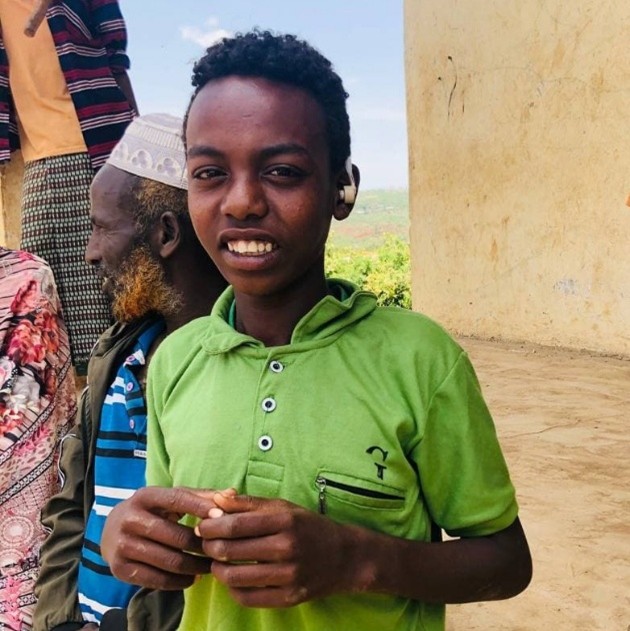
Bahar’s experience reflects this reality. After losing his hearing at a young age, communication became a daily barrier. Conversations grew shorter. Social connections faded. He spent long periods at home while other children went to school. He did not lack interest or ability. Rather, the systems around him were not equipped to support how he communicated. When Bahar joined Speed School, the first shift was not academic. It was relational.
There, his facilitator focused on restoring communication through visual cues, simple tools, and consistent, caring interaction. This was not treated as a separate intervention, but as part of everyday classroom practice that also involves every classmate. Over time, Bahar began responding more freely, joining group activities, and reentering the social life of the classroom. His mother describes changes that extended beyond school, as he also began freely sharing ideas and plans for his future at home. For Bahar, inclusion began with being understood. Learning followed once that foundation was in place.
Odwong Richard: Building Trust and Belonging
Speed School classrooms are intentionally designed so that children learn with and from one another. Facilitators form small, mixed-ability groups that join students in learning, supporting one another rather than competing for the instructor’s attention. Facilitators monitor progress closely, adapting activities so that every child has the opportunity to participate. This structure benefits all learners, but it is critical for children with disabilities.
Now a Ugandan Speed School graduate, Odwong Richard suffers from a cranial deformity that left his peers and others viewing him as frightening or “other.” One community member recalled people saying that “everywhere he goes, you hear children crying.” Richard carried the weight of this ubiquitous ridicule and rejection for years, shaping how he moved through the world. This included his parents keeping him home and out of school, leaving him often to be defensive, and at times aggressive – reinforcing the labels placed on him and deepened his isolation.
When Richard enrolled in Speed School, his peers were initially afraid of him, and early group work frequently broke down in conflict due to fear and misunderstanding. Rather than removing him from shared activities, as many teachers might do, his facilitator looked more closely at what was happening and recognized a strong desire for acceptance beneath the behavior.
With intention and care, his facilitator closely guided and encouraged Richard in his structured group work. He made sure that his peers gave him meaningful responsibilities, slowly cultivating trust and confidence by Richard and his groupmates through small successes. Over time, he began to reframe the experiences of disagreement during teamwork as a part of learning rather than something that posed a threat. His behavior softened. He became calmer, more engaged, and increasingly willing to participate. By the end of his time in Speed School, he volunteered during reading lessons, accepted help from classmates, and spoke openly about his hope of becoming a doctor.
The change was visible in his peers, as well. Children who had once avoided Richard began to sit with him, work alongside him, and correct mistakes with him as they would with any classmate. Through sustained interaction, they began to recognize the assumptions they had learned in their community and to see where those assumptions were wrong. Learning alongside Richard challenged their fear, deepened their understanding and acceptance of difference, and helped them develop empathy and patience that extended beyond the classroom. Inclusion shaped not only Richard’s confidence, but also the values and perspectives of the children learning with him.
“Inclusion of students with disabilities in the general classroom has many benefits for all students in the classroom, not just students with disabilities. Including students teaches all students kindness, compassion, and patience. For special education students, inclusion increases confidence, social skills, helps to create a sense of belonging, and makes learning more enjoyable.” – Tara Jensen, University of North Dakota
Kedir: Access, Confidence, and Participation
For many children, inclusion also requires addressing practical barriers that prevent participation altogether. Kedir, who has a visual impairment, spent years at home without access to school. When he joined Speed School, he received braille materials, a white cane, and classroom support that allowed him to engage fully in lessons.
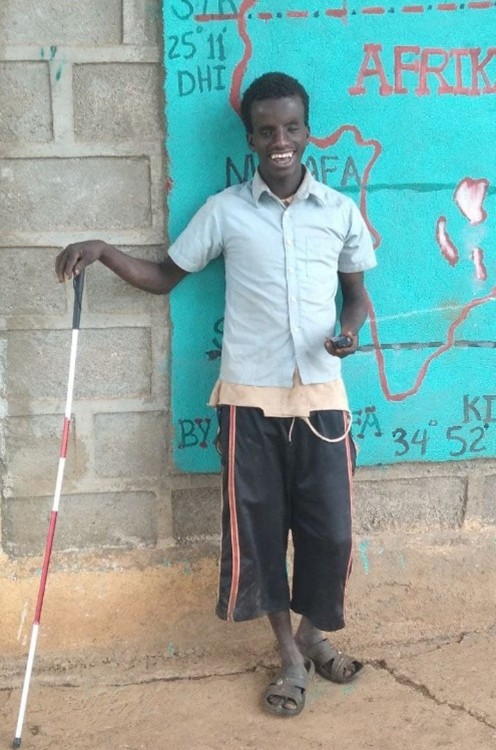
These tools gave Kedir materials that allowed him to read and learn. But once again, access alone was not enough. Learning to use them took time, encouragement, and a classroom environment where questions and struggle were welcomed as necessary for learning. Facilitators and peers supported Kedir to learn alongside them, adjusting routines, explaining tasks, and creating space for him to ask for help. His learning process sometimes looked different, but he was expected to participate fully.
Over time, Kedir learned how to keep pace, advocate for himself, and use his tools with confidence. He now participates actively in group work, often volunteers to speak on behalf of his classmates, and has developed a strong interest in environmental science. He has even taught his friends to read braille. He hopes to become a lawyer one day. His experience reflects how inclusive learning environments build not only access, but confidence and capability.
Together, these stories demonstrate that inclusion does not stem from a single intervention or accommodation. It is a set of daily choices by parents, teachers, classmates, and children themselves that shape how and how well they learn, how they relate to others, and how families also experience belonging. If these social and pedagogic elements are not present for children with disabilities alongside the introduction of devices and specialized learning accommodations, many children will not succeed in school or experience meaningful inclusion.
When classrooms are designed with intention, children with disabilities are not the only ones who change. Nor are they the only ones to benefit. Peers learn to question assumptions, teachers learn to respond with care rather than exclusion, and families begin to see new possibilities for their children.
The experiences of Bahar, Richard, and Kedir remind us that inclusive education is not simply about access to school. It is about restoring communication, rebuilding trust, and creating environments where difference is met with curiosity and mutual learning and joy rather than fear. It is about ensuring that children are supported not only to learn, but to be known and valued within their communities.
Speed School remains committed to this work, strengthening inclusive practices that recognize the full potential of every child and the shared responsibility of the communities around them. Practiced with care and consistency, inclusion strengthens learning and reshapes how children, families, and communities understand one another.