
The organizers of this year’s CEP conference had no small task ahead of them. 2025 has been marked by unprecedented attacks on civil society and the onset of an aid vacuum with dire consequences to global health and development — not just statistics, but actual lives and livelihoods — and the nonprofit sector at-large, targeted by those in power and overburdened on all fronts, is once again expected to overdeliver.
CEP met this moment by shaping an agenda focused on the current state of philanthropy and civil society; providing tactical and practical tools, approaches, and insights to navigate this new era of philanthropy; and frequently reiterating a call for moral courage, leadership, solidarity, and resilience.
Reflections on Plenaries and Breakouts
“It’s time to spend the money to support the communities we say we care about” — Tony Richardson, Gund Foundation
This moment is unprecedented, and the resounding call to action is for funders to do more — far more — than they are, say they are, or think they’re doing. CEP’s recent report is a clear bellwether that most funders are not meeting the moment or nonprofits’ needs.
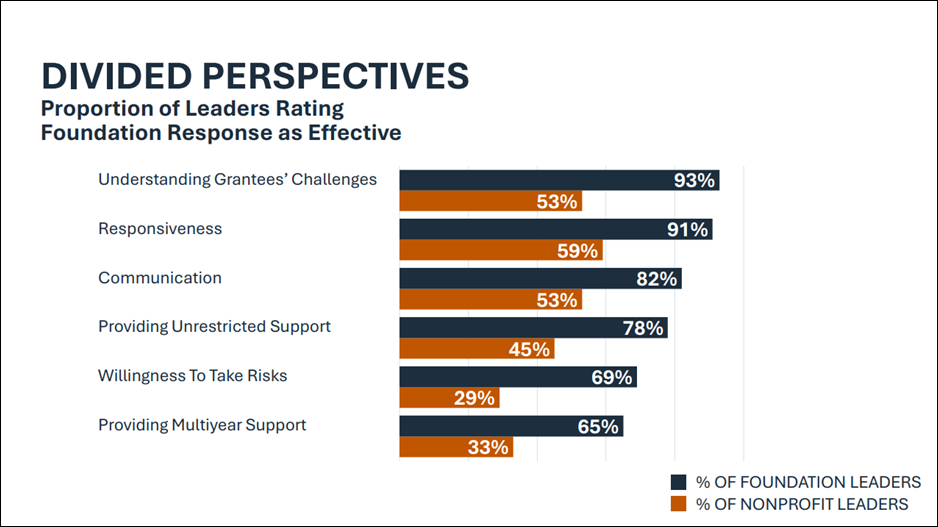
In the US, foundations gave almost $110 billion last year (Giving USA) and, as of 2023, collectively held over $1.48 trillion in assets (NPT). This level of wealth underscores the question: how are funders using their resources to meet today’s challenges?
A handful of funders are proving that it’s possible to go beyond the minimum and demonstrating what bold action can look like. The MacArthur Foundation, for instance, has increased its annual 5% payout to 6%, issuing an additional $62 million in grants and reducing reporting and application burdens for grantees. The Marguerite Casey Foundation has tripled its payout to $130 million this year.
Like these peers, many funders have the choice to increase payout — whether 1% or 100% — and set up response funds, along with other unrestricted buckets of funding for their grantees and community partners.
“Philanthropy has never met a problem it couldn’t overcorrect for” — Dimple Abichandani
More money is not the answer, or the only answer. The breakouts I joined emphasized the need for reframing how we as practitioners talk about social change and how we make it happen—changing narratives, adopting new tools, and reaching and listening to overlooked audiences.
Additionally, many of the reporting and due diligence structures (like many institutions and policies, one might argue) are relics of a different era and failing to meet the needs of the 21st century. Funders have the control to change their practices to support their nonprofit partners better, thus broadening their impact in the communities they care about.
However reluctant or risk-averse an organization’s Board may be, having a conversation is the best next step toward understanding what’s possible and can evolve to meet this moment.
“The people with the most optionality have decided they have the most to lose.” — Ezra Klein, NY Times
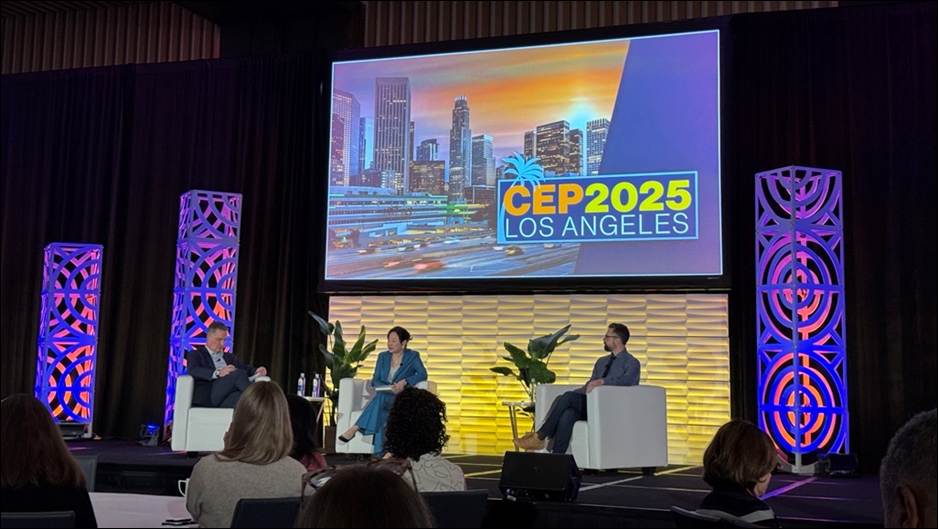
Across all sectors, but especially civil society, we need moral courage, leadership, solidarity, and resilience right now. Funders and philanthropy professionals alike, often on the most comfortable side of the proverbial table, have both an opportunity and an obligation to the communities they serve and the liberal democracy that allows them to exist — and the choice to use and move resources more urgently and efficiently.
When liberal democracy isn’t delivering, it is the critical moment for philanthropy to practice how many of us describe it — the risk capital for social change — and take that risk.
Personal Reflections
As winter sets in and I reminisce about the California sunshine and warm weather (…and burritos…), I am grateful for the learnings and reflections I gained. When I think about why I got into philanthropy—aside from sort of stumbling into the profession itself—ultimately, I believe in the ability to change outcomes and solve problems through the right use of resources and the right kinds of partnerships at the right time.
In my early life growing up in rural Maine, I remember door-to-door fundraisers for school trips or pre-GoFundMe medical fundraisers for community members. (My hometown is, unfortunately but aptly, nicknamed the ‘Cancer Valley’.) Yet in the early 2000s, my rural school district participated in the Maine Learning Technology Initiative — in essence, a public-private partnership — which greatly contributed to my understanding of how to use technology effectively and critically. Later, my college financial aid largely represented grants that allowed me to explore my interests, study abroad, and complete internships to hone my skills. I share these factoids as specific examples of where philanthropy, generosity, and practicality all converged in my life to shape my work and my outcomes.
As funders think about how and where they can do more right now, they don’t need to look far; they just need to listen and respond. If you’re a funder looking for inspiration as we head into 2026, I suggest the Chronicle of Philanthropy’s November/December edition: What’s Next? Predictions for 2026.
Additional Reading
- Mounting Pressure: U.S. Foundations and Nonprofits on the 2025 Political Climate | The Center for Effective Philanthropy
- Giving USA 2025: U.S. charitable giving grew to $592.50 billion in 2024, lifted by stock market gains | Giving USA
- The DAF Report | National Philanthropic Trust
- Stepping Up Takes Many Forms: A Set it at Six Update | John Palfrey, MacArthur Foundation
- Why the Marguerite Casey Foundation is leveraging its endowment |Dr. Carmen Rojas, Candid
- What’s Next? Predictions for Philanthropy, 2026 | Amy Saltzman and Nandita Raghuram, The Chronicle of Philanthropy
- USAID shutdown has led to hundreds of thousands of deaths | Karen Feldscher, Harvard T.H. Chan School of Public Health
- A New Era of Philanthropy: Ten Practices to Transform Wealtth into a More Just and Sustainable Future | Dimple Abichandani
About the Author
Josh Maillet is a Philanthropy Advisor at Geneva Global, advising clients on their global partnership development, event preparation and project management, research publication, and strategy implementation efforts. In his time at Geneva Global, Josh has supported US-based and international program officers, with regional focuses on China, India, SE Asia, and the Middle East. Josh is a contributing author to the recent Geneva Global and Gates Foundation white paper, Charting the Constellation of Advisors: Where do Philanthropists Get Expert Advice?
Based in Philadelphia, Josh holds a BA in Global Studies and French & Francophone Studies from Colby College. In his free time, Josh enjoys traveling and exploring new places; listening to records and finding new music; and catering to the many whims of his tabby cat, Huey.